

Vacuum-Sealed 10L Expandable Hopper: Fresh Food for 30 Days, Humidity-Proof
Release time: 2026-10-15
Table of Contents
Dry pet food is marketed for convenience and longevity, yet its nutritional integrity begins to decline the moment the bag is opened. Every time kibble is exposed to ambient air, oxygen and moisture initiate a steady process of fat oxidation, nutrient degradation, and texture loss. For pet parents who rely on automated dispensers, this creates an ongoing dilemma: buy a compact feeder that requires constant refilling, or invest in a large-capacity model where kibble sits stale for weeks.
A modern vacuum food storage pet feeder eliminates that compromise. By pairing active negative-pressure sealing with a modular 10-liter hopper, pet owners can store up to a full month of dry food without sacrificing crunch, aroma, or nutritional value—even in high-humidity environments.
The Science of Kibble Degradation: Why Standard Feeders Fall Short
Most pet owners assume dry kibble stays fresh as long as it remains inside a closed container. In reality, standard gravity bins and conventional automatic feeders offer minimal protection against the two primary catalysts of spoilage: oxygen and atmospheric moisture.
1. Lipid Oxidation and Nutrient Loss
High-quality dry pet foods are coated with animal fats, fish oils, and fat-soluble vitamins (such as Vitamins A, D, E, and K) to enhance palatability and support skin, coat, and joint health. When exposed to oxygen inside a non-sealed hopper, these unsaturated fatty acids undergo lipid oxidation. Within 7 to 14 days of open-air exposure, kibble loses its savory aroma, develops rancid off-notes, and suffers measurable drops in essential omega-3 and vitamin potency. Picky cats and dogs often reject oxidized kibble long before humans detect any change in odor.
2. Humidity Absorption and Clumping
Dry kibble is hygroscopic—it actively pulls moisture from the surrounding air. In coastal cities, tropical regions, or air-conditioned homes experiencing seasonal humidity spikes (relative humidity above 60%), unsealed kibble rapidly absorbs water vapor. Beyond turning crunchy pellets soft and unappealing, elevated moisture levels inside a feeder create an ideal breeding ground for storage mites, mold spores, and mycotoxins. Mechanically, damp kibble also swells and sticks together, causing frequent jams in automated dispensing rotors.
3. The Limitations of Passive Seals
Many mid-tier automatic feeders rely on a rubber lid gasket and a small silica desiccant pack to combat staleness. While better than an open bin, passive gaskets cannot remove the oxygen already trapped inside the hopper. Worse, as the food level drops over the course of a week, the empty headspace fills with humid room air every time the dispensing chute opens. Desiccant packs saturate quickly in damp climates, losing their effectiveness within days.
Active Vacuum-Sealed Technology: Locking in 30-Day Freshness
True long-term preservation requires removing air from the storage chamber altogether. Active vacuum-sealing technology applies commercial food-preservation principles directly to daily pet feeding.
How Negative-Pressure Preservation Works
Instead of passively trapping stale air inside the hopper, an integrated micro-vacuum pump actively evacuates oxygen and water vapor through a one-way valve until the chamber reaches a calibrated negative pressure (typically between −15 kPa and −25 kPa). This low-oxygen environment slows lipid oxidation to a fraction of its normal rate and prevents ambient humidity from penetrating the food supply.
Automated Pressure Monitoring
A single vacuum cycle at refill time is not enough for an active dispenser. Advanced vacuum-sealed hoppers incorporate internal barometric sensors that continuously monitor chamber pressure. Whenever the lid is opened for refilling—or if micro-pressure shifts occur over several days of scheduled meal dispensing—the system automatically triggers a brief re-evacuation cycle to restore the vacuum seal.
Comparing Pet Food Storage Methods
The table below illustrates how active vacuum sealing outperforms traditional storage and dispensing approaches across key preservation metrics.
| Storage Method | Oxygen Control | Humidity Protection | Peak Freshness Window | Pest & Odor Containment | Maintenance Effort |
|---|---|---|---|---|---|
| Open Bowl / Gravity Bin | None (continuous exposure) | None | 1–3 days | Poor (attracts ants/mites) | High (frequent waste) |
| Standard Automatic Feeder | Low (trapped headspace air) | Minimal | 5–7 days | Moderate | Moderate |
| Gasket + Desiccant Feeder | Low (air remains inside) | Moderate (until pack saturates) | 10–14 days | Good | High (frequent desiccant swaps) |
| Active Vacuum-Sealed Hopper | High (evacuated negative pressure) | Superior (humidity-proof seal) | Up to 30 days | Excellent (airtight lock) | Low (automated pressure maintenance) |
By maintaining a consistently dry, low-oxygen microclimate, active vacuum technology ensures that the last scoop dispensed on Day 30 retains the same crisp texture and rich aroma as the first scoop poured from a freshly opened bag.
Modular Capacity: Inside the 10L Expandable Hopper Design
Preservation technology solves the freshness problem, but capacity planning presents a separate challenge. Pet households are not static. A single kitten eventually grows into an adult cat; a one-dog home may welcome a second companion; and pet parents who normally work from home occasionally take extended business trips or vacations.
Fixed-capacity feeders force buyers into a rigid footprint. A 3L or 4L feeder looks sleek on a kitchen floor but runs dry in less than a week for medium-to-large dogs. Conversely, an oversized 10L fixed barrel dominates small apartments and wastes counter or floor space during everyday use.
Scalable Architecture for Evolving Needs
The 10L expandable pet feeder addresses this through modular engineering. Designed with a precision-locking vertical extension chamber, the hopper transitions seamlessly between a compact everyday profile (typically 5L to 6L) and a full 10L high-capacity configuration.
- Compact Daily Mode (5L–6L): Ideal for studio apartments, single-cat households, or small dog breeds during normal routines. It maintains a low center of gravity and minimal visual footprint while holding roughly two to three weeks of kibble.
- Expanded Travel & Multi-Pet Mode (10L): By attaching the airtight extension module—engineered with matching food-grade silicone locking rings—owners instantly double their storage volume without purchasing a second appliance. The vacuum pump automatically calibrates its evacuation cycle to handle the larger chamber volume effortlessly.
Real-World Autonomy: How Long Does 10L Actually Last?
Because kibble density varies by brand and pellet size (averaging roughly 400 g to 450 g per liter), a 10L hopper holds approximately 4.0 kg to 4.5 kg (8.8 lbs to 10 lbs) of dry food. The table below outlines estimated feeding durations across common household scenarios.
| Household Profile | Average Daily Intake | Standard Mode (5L / 2.1 kg) | Expanded Mode (10L / ~4.2 kg) | Recommended Mode |
|---|---|---|---|---|
| 1 Adult Cat (4–5 kg) | 60 g – 70 g | 30–35 days | 60+ days (30-day optimal cycle) | Standard or Expanded |
| 2 Adult Cats | 120 g – 140 g | 15–17 days | 30–35 days | Expanded 10L |
| 1 Small Dog (< 10 kg) | 110 g – 140 g | 15–19 days | 30–38 days | Expanded 10L |
| 1 Medium Dog (15–20 kg) | 220 g – 280 g | 7–9 days | 15–19 days | Expanded 10L |
| 1 Large Dog (30 kg+) | 380 g – 450 g | 4–5 days | 9–11 days | Expanded 10L |
For single-cat owners, two-cat households, and small-dog parents, the 10L capacity effortlessly crosses the 30-day autonomy threshold. For medium and large breed owners, it transforms a twice-weekly refilling chore into a relaxed biweekly routine—and ensures ample reserves during week-long trips.
Engineered for Humidity-Proof Performance in Real-World Climates
Maintaining a vacuum seal in a laboratory is straightforward; sustaining it inside a home kitchen during a humid summer is an engineering feat. Moisture does not only enter through the top lid—it creeps upward from the feeding bowl through the dispensing chute.
The Sealed Airlock Dispensing Chute
A weak point in conventional feeders is the open pathway between the food reservoir and the outside bowl. Even with a sealed lid, humid air rises up the chute, softening the kibble sitting directly above the impeller and inviting insects inside.
A well-engineered vacuum food storage pet feeder isolates the main hopper using a dual-barrier dispensing mechanism. A soft, food-grade silicone rotor forms a tight seal within the dispensing chamber, while a motorized or spring-loaded airtight exit door remains firmly shut between meals. The door opens only for the few seconds required to drop a measured portion into the bowl, then snaps shut immediately. This airlock design delivers three critical benefits:
- Zero Moisture Backflow: Steam from nearby dishwashers, humid coastal breezes, and ambient room moisture cannot migrate up into the dry hopper.
- Complete Pest Defense: Ants, cockroaches, and pantry moths cannot access the food reserve through the chute.
- Odor Containment: Strong-smelling fish or lamb formulas stay locked inside the chamber, keeping living spaces fresh and discouraging food-motivated pets from pawing at the machine.
Precision Feeding, Smart Control, and Everyday Hygiene
Superior storage must be matched by reliable dispensing mechanics and hygienic materials. When an automated system is entrusted with a pet’s nutrition for up to 30 days, every component must operate with consistent precision.
Anti-Jam Dispensing Mechanics
High-capacity hoppers place greater downward weight on the dispensing rotor. To prevent motor strain or pellet crushing, modern systems utilize high-torque motors paired with flexible, food-grade silicone impellers and infrared blockage sensors. If an irregularly shaped kibble or freeze-dried piece causes resistance, the motor automatically reverses to clear the obstruction before completing the portion delivery.
Hygienic 304 Stainless Steel Bowl
Plastic feeding bowls develop microscopic scratches over time, harboring bacteria that can trigger feline chin acne and skin irritation. A removable, dishwasher-safe 304 stainless steel bowl provides a non-porous, odor-resistant eating surface. An angled bowl geometry also helps center the kibble, preventing whisker fatigue in sensitive cats and ensuring pets can finish every piece comfortably.
Smart App Scheduling and Dual Power Redundancy
Through Wi-Fi app integration, pet parents can customize up to 10+ daily meals with precise portion control (typically adjustable in 5 g to 10 g increments). Real-time push notifications alert users to completed feedings, low food levels, vacuum status, or power interruptions.
To guarantee uninterrupted operation during grid outages, a dual power supply—combining a standard braided chew-resistant AC adapter with backup alkaline or rechargeable batteries—ensures that scheduled meals dispense on time even if home Wi-Fi or electricity goes down.
Long-Term Value Through Modularity
Investing in an expandable pet feeder also makes strong financial and practical sense. Rather than outgrowing a starter unit when a puppy reaches adulthood or when a family adopts another pet, owners simply expand the existing hardware. Every detachable component—from the extension chamber and silicone sealing rings to the dispensing impeller and stainless steel bowl—is designed for straightforward, tool-free disassembly and cleaning, protecting both the hardware and pet health over years of daily use.
Who Benefits Most from a Vacuum-Sealed, 10L Expandable System?
While any pet parent appreciates fresher food and fewer chores, this dual-innovation design solves acute pain points for four specific groups:
- Residents of Humid Climates: Pet owners living in coastal areas, the southern United States, Southeast Asia, or regions with rainy monsoon seasons can finally store bulk kibble without worrying about soggy pellets, clumping, or mold.
- Frequent Travelers and Busy Professionals: Combining 30-day freshness with 10L capacity provides genuine peace of mind during unexpected overtime, weekend getaways, or extended travel (paired with appropriate pet-sitting check-ins for water and companionship).
- Multi-Pet Households: Feeding two or three pets drains standard 4L feeders rapidly. The 10L hopper drastically cuts down on weekly refilling while ensuring every pet receives fresh, consistent portions.
- Owners Feeding Premium or Freeze-Dried-Coated Kibble: High-protein, grain-free, and freeze-dried-infused diets contain higher levels of natural fats and delicate nutrients that oxidize faster than budget kibble. Vacuum storage protects that nutritional investment from the first meal to the last.
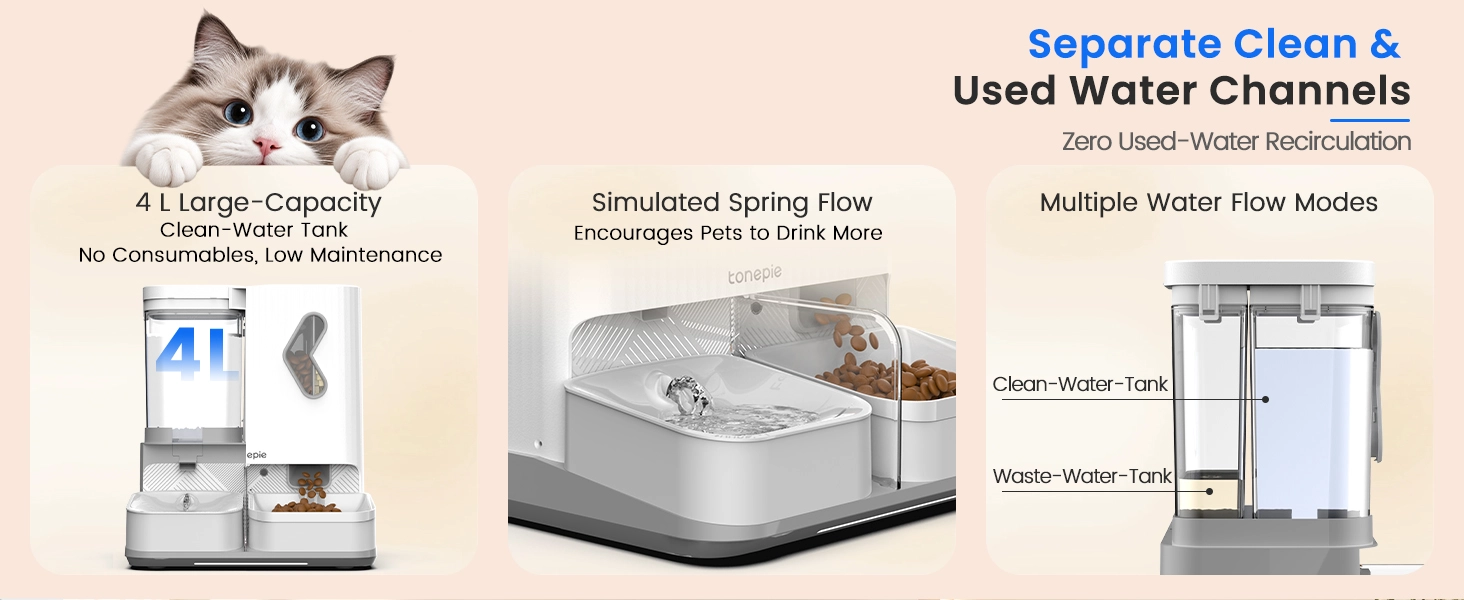
Tonepie O1/O1 Max Smart 2-in-1 Pet Feeder & Water Dispenser
Conclusion
Pet nutrition should never degrade simply because it is stored for convenience. By uniting active negative-pressure vacuum sealing with a modular 10L expandable hopper, modern feeding technology bridges the gap between bulk storage and peak freshness. Humidity stays out, essential fats and vitamins stay intact, and your feeding setup scales effortlessly alongside your household—delivering crisp, appetizing meals for up to 30 days at a time.
FAQ
1. Is the vacuum pump loud enough to frighten sensitive cats or dogs?
No. Modern vacuum-sealed pet feeders use low-decibel micro-diaphragm pumps engineered to operate at roughly 35 dB to 45 dB—comparable to a quiet refrigerator hum or a soft whisper. Furthermore, the pump only runs briefly right after the lid is closed or during occasional automated pressure top-ups, lasting just a few seconds so it will not startle anxious pets during mealtime.
2. What kibble sizes and food types are compatible with the vacuum-sealed dispensing mechanism?
Most systems smoothly dispense standard dry kibble, air-dried food, and kibble mixed with freeze-dried pieces ranging from 2 mm to 15 mm (up to 18 mm on wider-chute models) in diameter. Because vacuum sealing protects delicate fats from moisture and oxidation, it is especially beneficial for freeze-dried-coated kibbles. However, wet food, canned food, and semi-moist raw diets should not be used in dry automated dispensers.
3. Does the hopper lose its vacuum seal if the power goes out?
No. The negative-pressure seal is maintained mechanically by airtight silicone gaskets and one-way check valves, meaning it does not require continuous electricity to stay sealed. During a power outage, the chamber remains airtight and humidity-proof, while the backup battery system seamlessly takes over to dispense scheduled meals on time without interrupting your pet’s routine.