

How Air-Curtain and Spray-Type Odor Removal Keeps Homes Fresh for 10+ Days
Release time: 2026-09-23
Table of Contents
For indoor cat owners, odor management is rarely a one-time problem—it is a continuous battle against chemistry and airflow. Even with diligent daily scooping, lingering litter box smells can quickly permeate apartments, bedrooms, and open-plan living spaces. When work schedules tighten or weekend travel comes up, traditional litter boxes and basic self-cleaning units often fail within 48 to 72 hours, leaving behind an unmistakable ammonia odor that undermines home comfort.
Modern pet-care engineering has moved past simple plastic hoods and passive charcoal pads. By combining aerodynamic containment with active molecular neutralization, an air curtain odor elimination litter box paired with automated micro-mist spraying represents a structural leap in indoor hygiene. Rather than merely hiding odors or delaying their escape, this dual-action architecture intercepts airborne particles at the threshold and breaks down odor-causing compounds at the source—keeping homes genuinely fresh for 10 days or longer.
The Chemistry of Litter Box Odor: Why Passive Solutions Fail
To understand why dual-action odor control works so effectively, it helps to examine what actually causes litter box smells. Feline waste releases a complex mixture of volatile organic compounds (VOCs), primarily ammonia (), hydrogen sulfide (), and sulfur-containing mercaptans.
When a cat urinates, urea in the urine is rapidly broken down by urease-producing bacteria into ammonia gas. Ammonia is lighter than air and highly volatile, meaning it disperses into the surrounding room almost immediately upon exposure. Solid waste introduces mercaptans and skatoles—dense, pungent molecules that cling to surrounding fabrics, litter granules, and plastic surfaces.
Traditional odor-control methods struggle against this chemistry for three reasons:
- Immediate Escape During Use: Even with a hooded box, odors escape through the entrance the moment a cat digs, eliminates, or steps out.
- Filter Saturation: Passive activated carbon filters rely on adsorption. In humid environments or multi-day storage scenarios, carbon pores saturate quickly, losing their effectiveness long before the owner remembers to replace them.
- Accumulation in the Waste Drawer: Standard automatic litter boxes sweep waste into a bottom bin, which improves aesthetics but concentrates decomposing waste in one enclosed pocket. Every time the sifting drum rotates or the waste chute opens, trapped gases surge back into the room.
Solving this requires a two-pronged engineering strategy: physical containment to stop odor plumes from escaping, and active neutralization to dismantle odor molecules before they accumulate.
Stage 1: Physical Containment via Air-Curtain Technology
Air curtains have long been used in commercial cleanrooms, laboratories, and climate-controlled entryways to separate two distinct air environments without a solid door. Adapting this principle to feline hygiene solves a classic design paradox: cats prefer open, accessible entrances rather than cramped, claustrophobic flaps, yet open entrances allow odors to drift freely into the home.
How the Aerodynamic Barrier Works
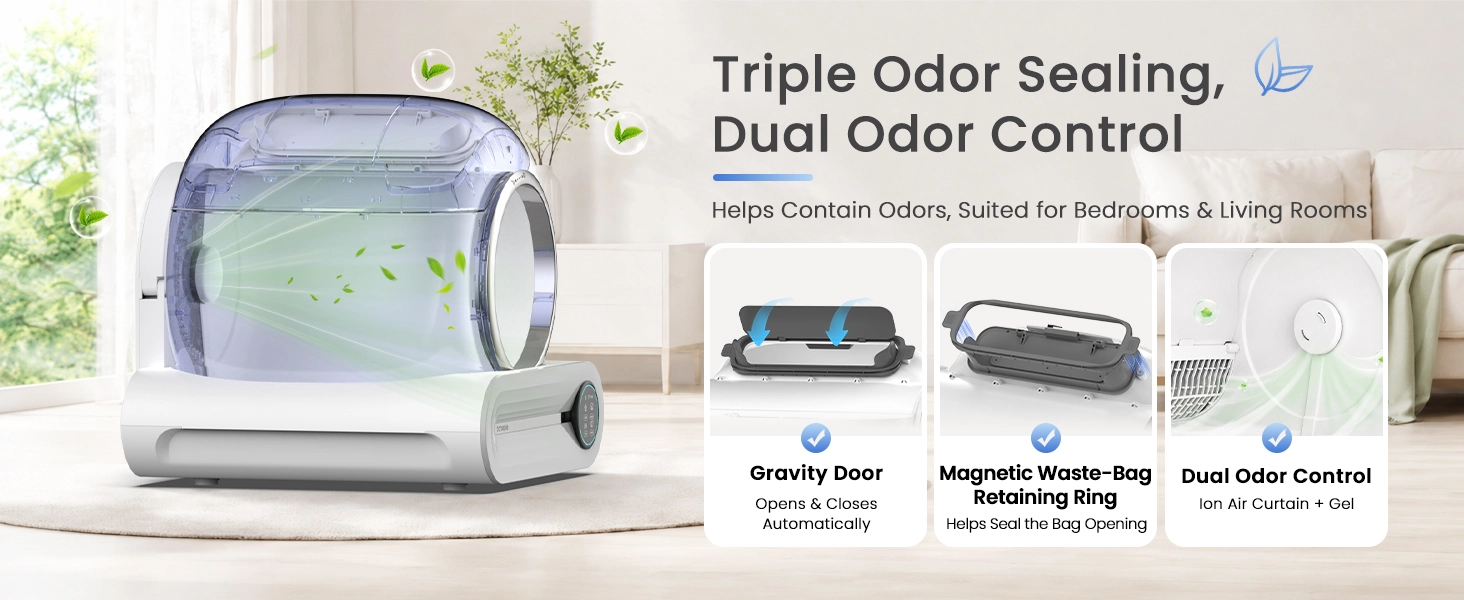
An integrated air-curtain system uses a precision-calibrated, low-noise brushless fan and a narrow directional vent positioned along the upper or side perimeter of the litter box entrance. When triggered—typically during a cat’s exit and throughout the automated sifting cycle—the system projects a smooth, laminar sheet of air across the opening.
This invisible barrier performs two simultaneous functions:
- Threshold Containment: The high-velocity, low-turbulence airflow creates a pressure differential across the doorway. Rising ammonia () and airborne dust particles hit the air curtain and are deflected back into the interior chamber rather than drifting into the living room.
- Directional Exhaust Routing: Inside the chamber, the redirected air is guided toward an internal filtration channel or held within the enclosed drum until the active deodorizing cycle neutralizes the trapped VOCs.
Because the barrier is made of air rather than a heavy swinging door, cats can enter and exit naturally without bumping their faces or feeling trapped. At the same time, the living space remains isolated from the sudden burst of odor that normally accompanies a freshly used litter box or an active cleaning cycle.
Stage 2: Active Neutralization with Spray-Type Odor Removal
Containing odors inside the machine is only half of the equation. If volatile compounds are merely trapped inside the globe or waste drawer without being neutralized, they will inevitably leak out over a multi-day period—especially when the bin reaches capacity or when the owner finally opens the drawer to empty it.
This is where a spray type odor removal cat litter box delivers decisive performance. Instead of masking smells with heavy synthetic perfumes—which irritate a cat’s sensitive olfactory system and often lead to litter box avoidance—advanced spray modules deploy ultrasonic or micro-nozzle atomizers loaded with pet-safe, plant-derived neutralizing agents.
Atomization vs. Conventional Spraying
A common misconception about spray-based deodorizers is that they dampen the litter, causing premature clumping or muddy residue. Modern smart litter boxes avoid this through micron-level atomization. The spray nozzle converts liquid deodorizer into an ultra-fine dry mist (typically droplets measuring ).
Because these micro-droplets are lightweight, they remain suspended in the air column inside the globe and waste compartment for several seconds rather than immediately falling onto the litter bed. During this suspension window, the active bio-neutralizing compounds collide with airborne ammonia, hydrogen sulfide, and mercaptan molecules.
Molecular Neutralization at the Source
The chemistry behind quality pet-safe sprays relies on encapsulation and enzymatic breakdown:
- Neutralization: Plant-derived flavonoids, organic acids, and natural surfactants bind directly to alkaline ammonia molecules, converting them into odorless, non-volatile salts.
- Microbial Suppression: Botanical antimicrobial extracts slow down the bacterial proliferation responsible for converting urea into fresh inside the waste bin.
- Surface Refreshing: A microscopic portion of the mist settles lightly on the waste chute and liner interior, forming a neutral barrier that suppresses lingering smells between cycles.
Crucially, the spray activates automatically after the cleaning cycle finishes and the cat has safely exited, targeting the exact moment when freshly sifted waste enters the storage drawer.
The Synergy: Why Dual-Action Outperforms Single-Method Systems
On their own, an air curtain and a spray deodorizer each address a specific failure point. Together, they create a closed-loop odor management cycle that significantly outperforms passive filters or single-method smart boxes.
When a cat finishes using the box, sensors detect its departure. As the sifting drum begins to rotate—the exact phase when buried clumps are disturbed and odor spikes—the air curtain activates to seal the entrance aerodynamically. Once the clumps drop into the sealed waste bin and the drum returns to its resting position, the spray module releases a calibrated burst of neutralizing mist into the chamber and waste zone. The air curtain then maintains containment briefly while the mist settles and binds to remaining VOCs.
The table below compares how this dual-action architecture stacks up against conventional litter box odor-control methods.
| Feature / Performance Metric | Open Traditional Litter Box | Hooded Box with Carbon Filter | Single-Method Automatic Box | Air-Curtain + Spray Dual-Action Box |
|---|---|---|---|---|
| Immediate Odor Containment | None; odors disperse freely into the room | Low; odors escape through flap gaps | Moderate; brief spikes during sifting cycles | High; laminar airflow blocks odor plumes at the threshold |
| Odor Control Mechanism | Litter absorption only | Passive adsorption (saturates rapidly) | Mechanical separation + basic carbon pad | Active molecular neutralization + aerodynamic barrier |
| Odor Buildup in Waste Bin | N/A (manual daily scooping required) | N/A (manual daily scooping required) | High after 3–5 days, especially in warm weather | Minimal; mist suppresses bacterial growth and neutralizes VOCs |
| Cat Entry Comfort | High (open access) | Low to Moderate (swinging doors deter some cats) | High (open entrance) | High (flap-free, unobstructed entry) |
| Effective Freshness Window | <24 hours | 1–2 days | 3–5 days before noticeable odor | 10+ days for a single-cat household |
| Owner Maintenance Effort | Daily scooping (high) | Daily scooping + frequent filter swaps | Emptying every 3–5 days | Emptying every 10–14 days (low) |
Achieving the 10+ Day Hands-Free Milestone
Large waste bins have existed in automatic litter boxes for years, yet bin capacity alone does not guarantee hands-free convenience. If a 12-liter waste drawer begins smelling unbearable on Day 4, its theoretical capacity becomes irrelevant—owners are forced to empty a half-full bag simply to restore indoor air quality.
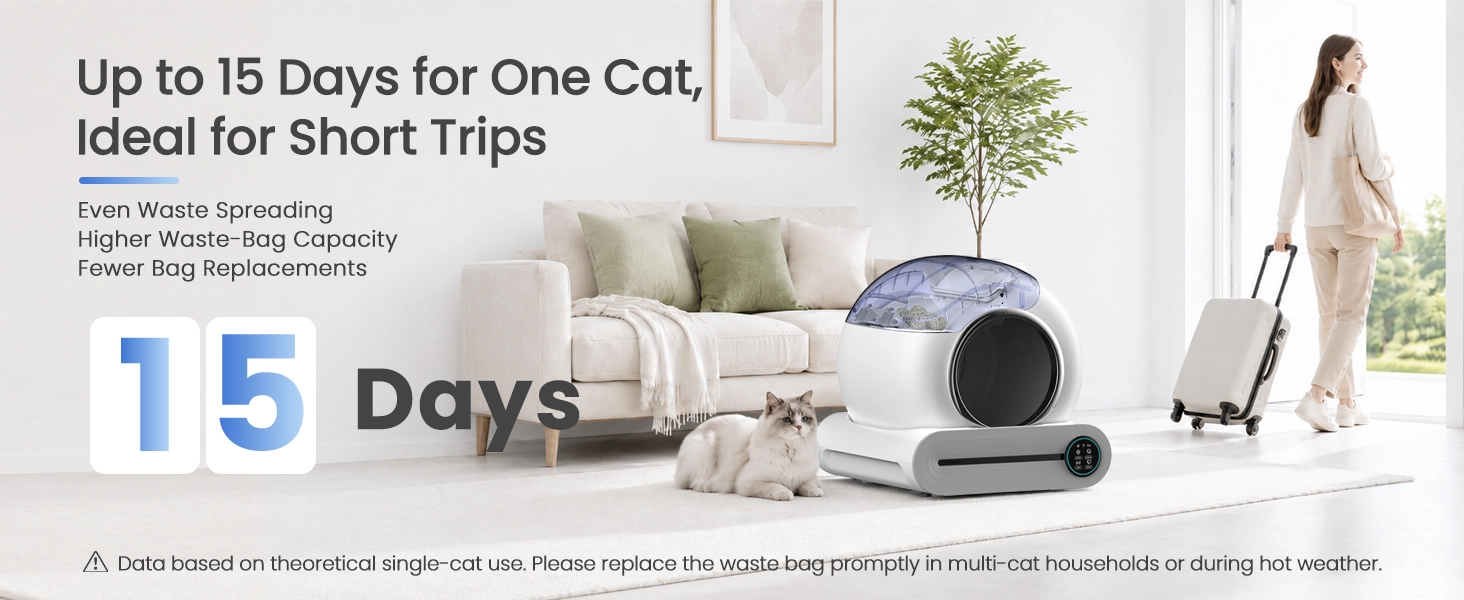
True multi-week autonomy requires matching generous waste storage with sustained odor suppression. A well-engineered single cat 10 days+ waste bin litter box integrates three essential design elements to make extended intervals practical:
- High-Efficiency Waste Compaction and Distribution: Precision sifting grates separate clean litter from clumps cleanly, preventing wasted clean granules from filling the drawer prematurely. Wide, flat waste bins distribute clumps evenly rather than piling them in the center and triggering false “bin full” alerts.
- Silicone-Sealed Waste Isolation: A tight-fitting chute door with a silicone gasket isolates the waste drawer from the main globe between cycles. This prevents stagnant air in the bin from rising back into the cat’s standing area.
- Cumulative Spray Neutralization: Because a small dose of neutralizing mist is applied after each cycle, waste sitting at the bottom of the drawer on Day 8 is not left to ferment unchecked. Each new deposit is treated, keeping the internal microclimate of the bin remarkably neutral.
What a 10+ Day Cycle Looks Like in Practice
For busy professionals, frequent travelers, or apartment dwellers, understanding how the system manages waste over time clarifies why 10+ days of freshness is sustainable rather than a marketing exaggeration.
| Timeline | Typical Single-Cat Waste Volume | Active System Operations | Indoor Odor Profile & User Action |
|---|---|---|---|
| Days 1–3 | 6–12 clumps (~25% bin capacity) | Automatic sifting after each visit; air curtain blocks sifting odors; post-cycle micro-mist neutralizes fresh NH3. | Zero detectable odor. No user intervention required. |
| Days 4–6 | 12–24 clumps (~50% bin capacity) | Cumulative neutralizing mist suppresses bacterial urease activity in older clumps; silicone gasket seals the drawer. | Fresh room air. Optional quick check of litter level via app or visual indicator. |
| Days 7–10 | 24–40 clumps (~80–90% bin capacity) | Air curtain prevents odor spikes as waste volume nears the chute; automated spray maintains neutral pH inside the bin. | Consistently fresh. App notifies owner when the drawer approaches full capacity. |
| Day 10–14 | Full capacity (~95–100% bin capacity) | Drawstring or pull-seal liner allows touchless disposal without releasing a blast of trapped gas. | Single 60-second task: Pull out the sealed bag, insert a fresh liner, and top up litter. |
Feline Safety, Comfort, and Acoustic Engineering
Any automated pet appliance succeeds only if cats accept it willingly. Felines have acute hearing and a sense of smell roughly 14 times stronger than humans. Introducing fans and sprays into their bathroom space therefore demands strict safety and acoustic engineering.
Intelligent Multi-Sensor Protection
To ensure a cat is never startled or exposed to spray mist, modern systems rely on redundant detection arrays—typically combining high-precision weight sensors, infrared beams, and millimeter-wave radar. The cleaning drum, air curtain, and spray atomizer remain strictly locked out whenever weight or motion is detected inside or near the entrance.
Furthermore, the spray cycle is programmed with a safety delay (often 15 to 60 seconds after the sifting cycle completes), guaranteeing that the cat has moved well away from the unit before atomization occurs.
Pet-Safe Botanical Formulations
Because cats groom their paws and fur frequently, the chemical profile of the deodorizing liquid is non-negotiable. Leading systems use alcohol-free, phenol-free, and essential-oil-free formulations (as many common essential oils like tea tree, eucalyptus, and citrus are toxic to cats). Instead, they rely on food-grade or veterinary-tested plant extracts and purified water, leaving no sticky residue on the drum or litter bed.
Whisper-Quiet Acoustics
If an air curtain odor elimination litter box sounds like a hairdryer, even the bravest cat will refuse to use it. High-end units utilize brushless DC (BLDC) motors and aerodynamically contoured air ducts to keep operating noise between and —roughly equivalent to a quiet library or a soft whisper. This ensures the unit can be placed in a bedroom, home office, or studio apartment without disrupting sleep or spooking timid pets.
What to Look for When Choosing a Dual-Action System
If you are upgrading from a manual box or an older automatic model, evaluating the engineering details will help ensure you get genuine 10-day performance:
- Refill Efficiency and Cost: Check how long a single deodorizing cartridge lasts. A well-calibrated spray type odor removal cat litter box should deliver 30 to 60 days of operation per refill cartridge, keeping ongoing maintenance affordable and effortless.
- True Waste Drawer Volume: Look for a waste bin rated at 10 L to 13 L or higher to comfortably support a single cat 10 days+ waste bin litter box schedule, especially if your cat drinks plenty of water or eats a high-moisture wet food diet.
- Washable, Modular Components: Even with superior odor control, periodic deep cleaning (every 4 to 6 weeks) keeps the unit hygienic. Choose a design where the globe detaches without tools and the air-curtain intake grille can be wiped clean of litter dust in seconds.
- Smart Monitoring: Companion apps that track waste bin capacity, deodorizer fluid levels, and cat bathroom frequency add both convenience and early health-monitoring value, alerting you to sudden changes in urination habits.
By uniting aerodynamic containment with targeted molecular neutralization, dual-action odor control transforms litter box maintenance from a daily chore into a quiet, background routine—preserving both your cat’s comfort and the freshness of your home for 10+ days at a time.
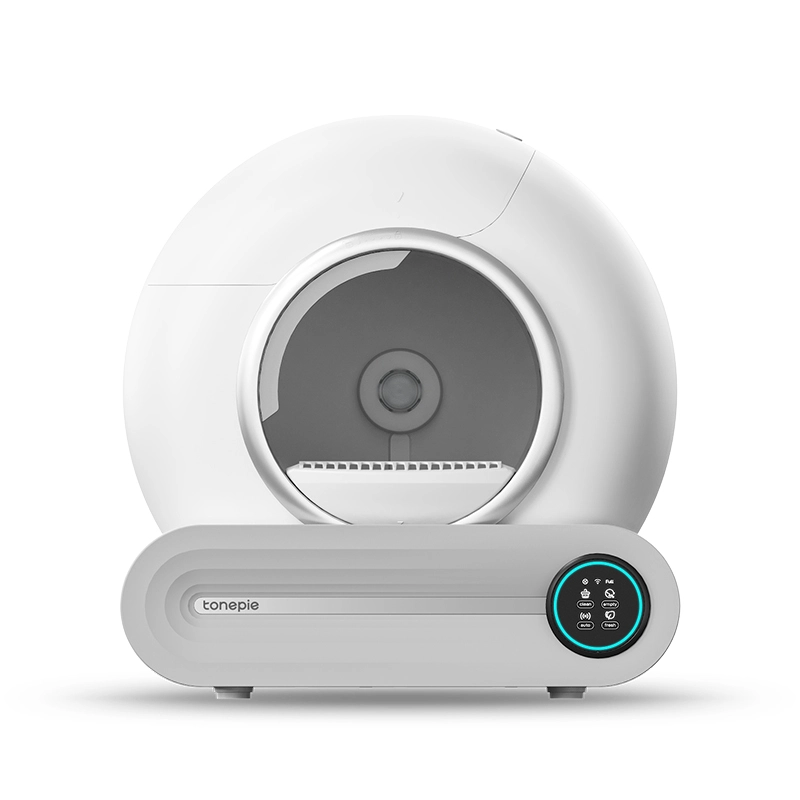
Find Tonepie Odor Removal Cat Litter Box
FAQ
1. Is the automated deodorizing spray safe for cats with sensitive respiratory systems or allergies?
Yes, provided you use the manufacturer’s veterinary-tested, pet-safe refill solution. Modern spray-type litter boxes are engineered to avoid harsh fragrances, phenols, alcohol, and feline-toxic essential oils. Instead, they use hypoallergenic, plant-derived bio-neutralizers delivered as an ultra-fine mist only after multi-sensor arrays confirm your cat has completely exited the area. Because the mist neutralizes odor molecules rather than saturating the air with heavy perfume, it is significantly gentler on sensitive feline airways than scented litters or plug-in air fresheners.
2. Does the air-curtain fan make too much noise or blow cat litter out of the box?
No. Properly engineered air-curtain systems use low-decibel brushless motors (typically operating around ) and direct a smooth, laminar sheet of air across the upper threshold of the entrance—well above the litter bed itself. The airflow is calibrated to intercept rising airborne gases like ammonia () without creating downward turbulence that would disturb or scatter litter granules. Most cats acclimate to the gentle hum within a few days.
3. How does a 10+ day waste bin prevent bacteria and odor buildup during warm or humid weather?
Warmth and humidity accelerate bacterial growth and ammonia release, which is why standard large waste bins often smell bad within three days in the summer. A dual-action system combats this on three fronts: a silicone-sealed chute isolates the waste drawer from ambient room humidity, the automated spray coats the waste zone with antimicrobial plant neutralizers after every cleaning cycle to slow bacterial decomposition, and the air curtain blocks any residual gas from escaping during sifting. For best results in very hot climates, pairing the unit with a fast-clumping, low-dust bentonite or tofu-blend litter ensures clumps stay dry and compact throughout the full 10-day cycle.